

Indigo artist Abishek Ganesh AKA Kaimurai’s obsession with the blue that has fascinated the world
%2C%206.3%20%20x%202.4%20ft%20each%2C%20.jpg)
“Indigo is a rebel dye,” says artist Abishek Ganesh Jayashree as he stands before his striking blue works in his new studio in Bangalore. “In the natural dye universe, there are many dyes, and they are mostly water-soluble.”
Indigo is an exception. Ganesh tells Object that since indigo is insoluble in water, it has to go through a reduction process—called a reduction vat—where the artist mixes it with lime, some kind of sugar, and tamarind. Before the reduction process, the dyed fabric is green. After taking it out, it oxidises, and starts turning blue.
“It’s like magic,” said Ganesh. “It has its own mannerisms. You might dye it, and then it starts bleeding. Not everybody gets it right. That’s why it’s a rebel dye.”
Ganesh, who lives and works in Bengaluru, goes by the creative alias ‘Kaimurai’, a Tamil phrase meaning “method of the hand”. Indigo is central to his practice, which he applies to khadi cloth using fine, repetitive brushstrokes layered with heavier marks. The fabric’s natural texture, and the way the dye bleeds into it, ensures that each work is distinct.
In April 2025, Ganesh presented a solo exhibition at Art Dubai, where he was one of just ten featured artists. Later that year, he created Through Me Runs the Ancient Water for Jodhpur Art Week, installing the work inside an old temple at a girls’ school in Jodhpur. Working with local sandstone carvers, he shaped a shrine-like space where indigo, khadi, and stone meet. “The sandstone took the dye beautifully,” he said with some surprise.
Ganesh will next show at the India Art Fair from February 5 to 8 in New Delhi. There, he plans to return to khadi, working with indigo on brown cloth while developing a theme he describes as “transcending duality”, moving beyond binary thinking towards complexity.
Ganesh’s pigment of choice carries a long and complex history. In 2016, archaeologists on Peru’s northern coast uncovered scraps of indigo-dyed textiles dating back to around 6,000 years. Reported by The New York Times, the find pushed the known history of indigo far beyond the nearly-4,000-year-old shrouds of Egyptian mummies, which had previously held that distinction.
“A marvellous mixture of purple and blue,” wrote Roman philosopher Pliny the Elder in the first century AD. He traced indigo to India and the plant Indigofera tinctoria, though the dye was independently developed across South America, Africa, and China.
By the sixteenth century, indigo’s beauty was inseparable from violence. In the Americas, plantations depended on enslaved African labour. After American independence, Britain turned to India, where colonial planters, backed by law, coerced farmers in regions such as Bengal to grow indigo instead of food. The system was exposed in Dinabandhu Mitra’s 1858 play Nil Darpan. A year later, resistance erupted in the Indigo Revolt.
By the mid-nineteenth century, natural indigo had become increasingly difficult to sustain. In 1865, German chemist Adolf von Baeyer synthesised indigo in the laboratory, paving the way for mass production decades later. Around the same time, Bavarian immigrant Levi Strauss began selling riveted denim trousers to American labourers. Indigo moved from ritual cloth and aristocratic dress into everyday workwear, and eventually to the world’s most worn garment: jeans.
It was denim that first fascinated Ganesh, who is now 41 years old. “I used to work as a fashion designer with the Aditya Birla Group in the mid-2000s, and I discovered I was passionate about denim,” he said. “Denim as a garment and also as a textile. I learnt that the indigo used in jeans is not really indigo. It’s a synthetic made to act like indigo. So then I began to explore and learn about natural indigo and how to adapt the pigment for painting.”
Ganesh graduated from the National Institute of Fashion Technology in Bengaluru in 2005 and spent the next fifteen years working in fashion and textiles. His middle-class family was initially shocked. “Back then, nobody had heard of NIFT. My family thought I had become a tailor,” he jokes. While the work gave him professional grounding, it did not still his desire for greater creative freedom.
Understanding how to paint with indigo took Ganesh years. “I went through the entire gruelling process from plant to pigment by learning it directly from farmers in Tamil Nadu,” he said. “For instance, I learnt that one needs to grow 100 kilos of the plant to produce ten kilos of indigo.”
What followed were numerous experiments in tempering the precious pigment for art. “I made a lot of mistakes. I mixed it [indigo] with wheat, soya and clay: whatever I could get that would work as a binder.” Eventually, he discovered that gum arabic worked best.
Once mixed, there is little time. “The indigo dries in about two days, so I need to finish what I am doing in that sitting,” said Ganesh. “I can’t come back after a week and restart.”
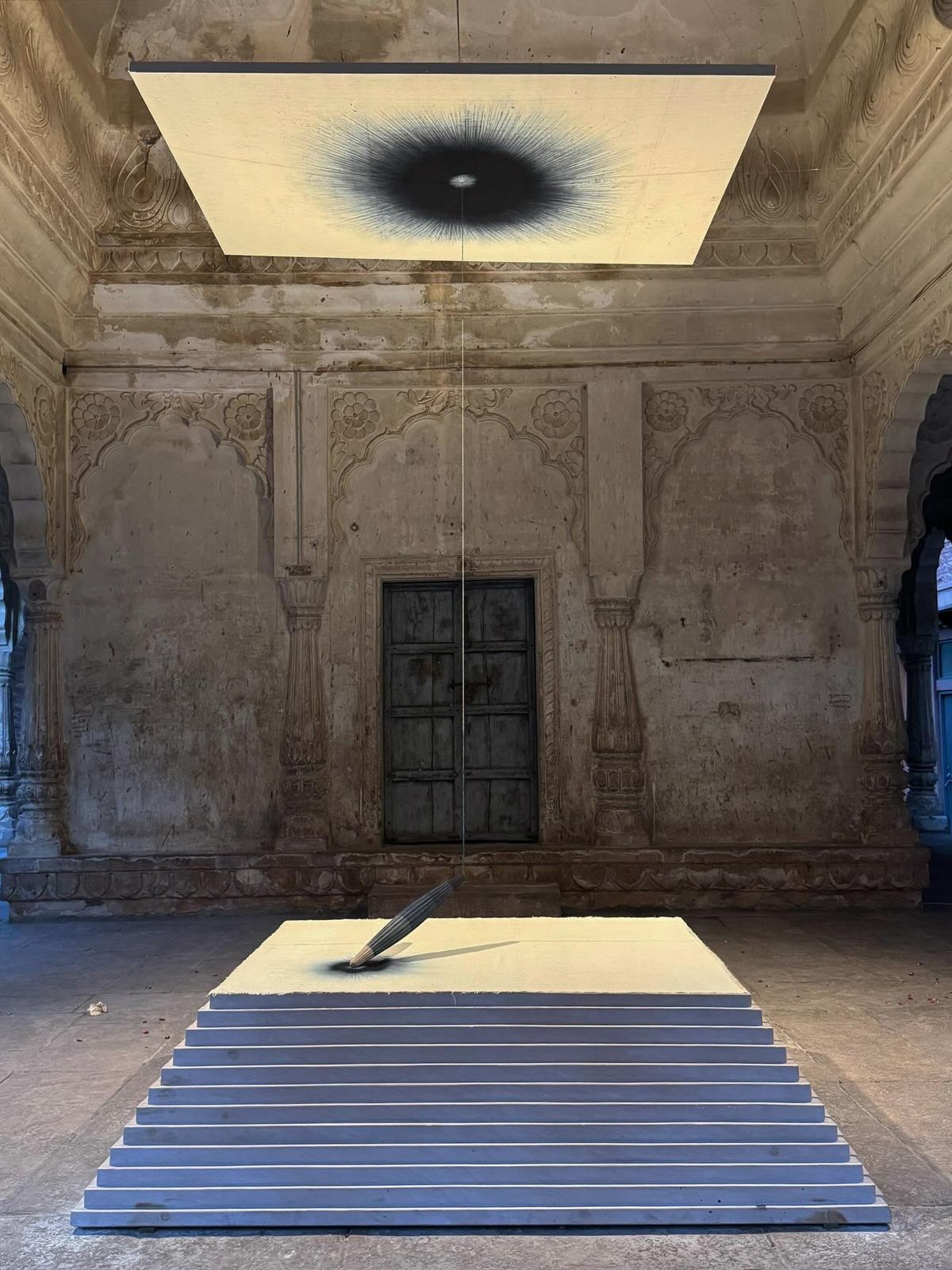
No matter how tedious, for Ganesh the process is deeply meditative. He calls indigo his vibhuti, an ash considered sacred in Hinduism, though he does not consider himself religious. Making marks with indigo on textile is a space where his hand takes over his mind.
That inclination began early. As a child, he found repetition calming, years before mark-making became central to his work. Born in Belthangady in Karnataka’s Dakshina Kannada district, he grew up surrounded by Carnatic music, the Western Ghats, and South Indian temple architecture.
These influences converge in Drigganita (2024), a body of work whose title refers to visual calculation. Drawing on forms such as sundials, chakras, and bindus, symbols linked to astronomical measurement in some Hindu traditions, the works explore rhythm and repetition. Executed in natural indigo, Drigganita was conceived as a “space of zero”, open to interpretation.
Music runs consistently through Ganesh’s practice. His father was an amateur musician, and Ganesh listens to Carnatic raagas on repeat while working. His Ambara series incorporated veena strings and gold foil associated with Tanjore paintings.
For the past four months, he has been listening to the raaga Neelambari, often used as a lullaby. That raaga, along with ideas of life and death, informs his upcoming exhibition at Sri Lanka’s contemporary art festival Colomboscape in January 2026. Among the works is a clay pot traditionally used to collect ashes after a Hindu cremation, placed beneath a khadi cradle marked with indigo stripes. The pairing draws on the Tamil philosophical idea Andamum Pindamum Ondre, which holds that the human body mirrors the universe.
The nature of Ganesh’s work requires space, which he considers vital to accessing his craft. His artistic process requires room for expansive khadi canvases, messy indigo vats, binders and tools, a rarity in a dense city like Bengaluru.
During the 2020 pandemic, he came across a row of small thotti manes, or traditional courtyard houses, while walking through upscale parts of Indiranagar in Bengaluru. Once intended as a santhe (a handicrafts fair), the houses were owned by the Bangalore Metro Rail Corporation (BMRCL) and stood locked and unused. “They were abandoned, so I asked them if I could rent one,” said Ganesh.
He ended up paying a daily rent, and worked and stayed there for more than three years. His only other neighbour was a woman selling Channapatna wooden toys. His thotti mane had only two tiny rooms with an open courtyard, ringed by wooden pillars. It was filled with natural light. Ganesh said, “It worked exactly like a thotti mane traditionally worked, when people had discussions with guests in the central courtyard. I worked on the floor there, and did not use electricity because it was so well ventilated.”
In 2023, the BMRCL asked Ganesh to leave ostensibly so that the space could be used to support rural women artisans develop skills. Two years on, it remains vacant.
His fate exemplifies a bigger problem: that of artists struggling to find studio space in metropolitan cities. With rents in Bengaluru starting at Rs. 40,000 rupees per month Ganesh went looking for warehouses instead but found that they were taken up by large corporations like Amazon or Swiggy as fulfilment centres.. “Meanwhile, places like the National Gallery of Modern Art in Bengaluru have so much unused space,” he rued.
Ganesh has since moved to the Banaswadi area of Bangalore, where he pays Rs 50,000 rupees per month for a spartan flat on a busy main road. He is now considering leaving the city altogether for a smaller town where space is cheaper.
Even as artists like him scout for affordable space for an indigo-focused craft, interest in this pigment is now reviving across the world. An ongoing exhibition at Hampi Art Labs titled Blue Futures: Reimagining Indigo brought together artists from India, France, and Japan to trace the dye’s journey across time and geography. In Charleston, South Carolina, indigo workshops and walking tours are offered near former slave plantations, a present-day history lesson in the pigment’s bloody history. Indian-American artists such as Bhasha Chakrabarti are revisiting the pigment through quilting.
Ganesh believes this reflects a quiet return to craft. A 2023 study published in the journal Advances in Materials Science and Engineering found that natural indigo now accounts for only a small fraction of global dye production despite its continued use in high-quality traditional textiles. It survives in traditions such as the Indian ajrakh and the Japanese shibori. Meanwhile, Levi Strauss & Co began selling natural indigo jeans in 2021 as part of its premium range, pricing them at nearly three times the cost of its standard synthetic-dyed denim. The company has since said it is investing in plant-based indigo, framing the move as part of its broader sustainability strategy.
In a twist of history, indigo has come full circle, once again a luxury material for discerning customers, much as it was centuries ago. Despite its brutal history, the so-called “devil’s dye” endures, and will reappear in new avatars as long as people continue to covet that deep, true blue. For Ganesh, that history is carried forward by hand, one mark at a time.


