

Sidhant Kumar negotiates the destructive speed of capitalism and the ruthlessness of migration in his multidisciplinary art
For Sidhant Kumar, art reveals itself in layers, and each time he peels them back, he finds Pachokhar, a village in Bihar’s Siwan district, waiting at the centre of his life. It was this village that he left as a young boy when his family moved to Nangloi on the fringes of West Delhi, a rupture that would shape his way of seeing, sharpen his artistic vision, and compel him to ask questions that refuse easy comfort.
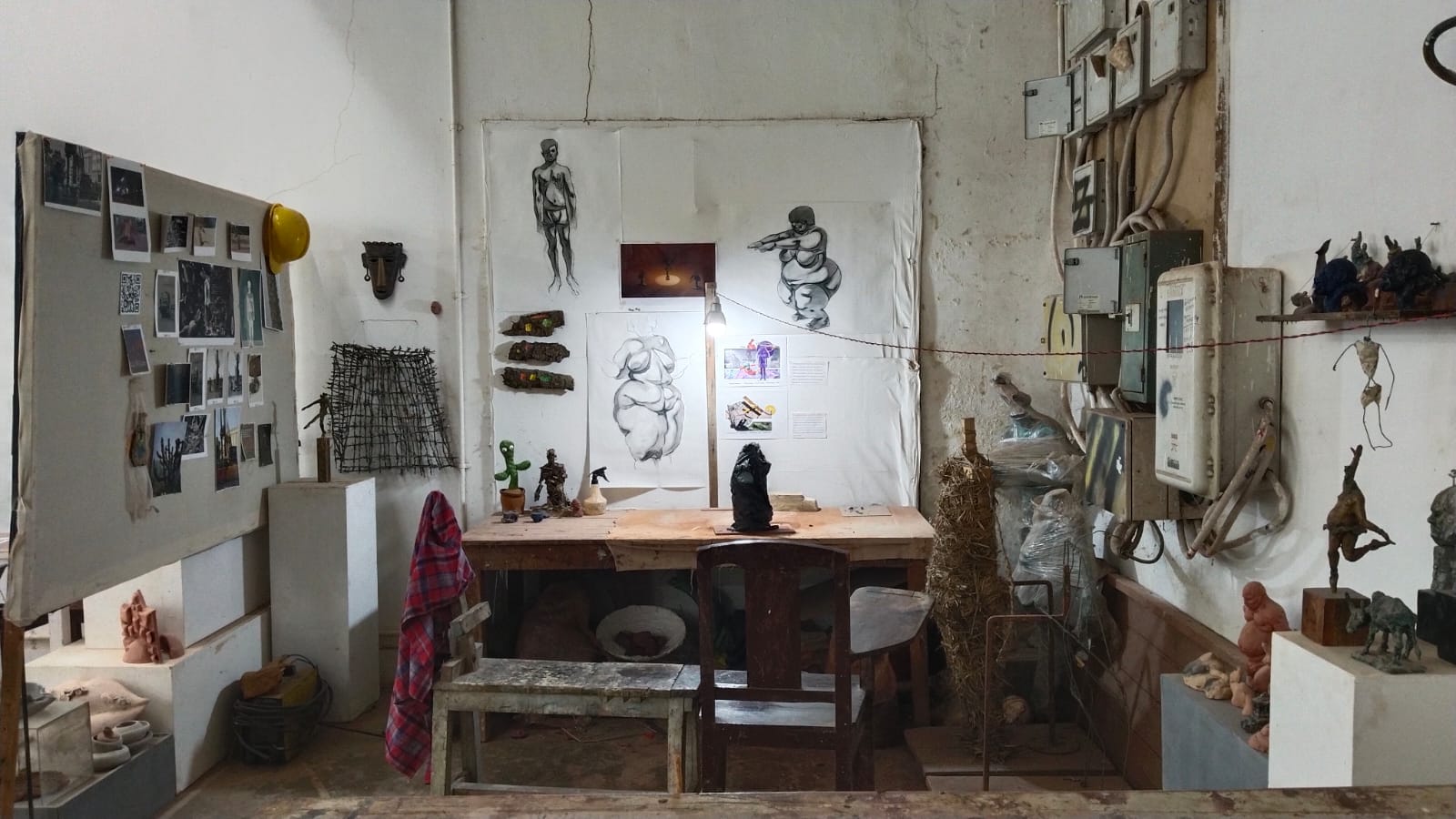
The village had offered him a sense of expansive time and bodily freedom; the city, by contrast, felt sealed and performative. It was through this lived experience of migration that he began to confront the entwined ecological and cultural crises of contemporary life. What took birth from this was a multidisciplinary form of art, the practice of which spans performance, video, installation, sculpture, and mixed media.
“Despite living in the city, my emotional life had deep ties to the village,” said Sidhant. Growing up in crowded urban spaces, he heard stories of seasons, sowing cycles, paddy fields, and rainfall. And yet, Nature reached him as blurred memory and narration, never as touch. The dissonance unsettled him but also whetted his curiosity.
From this curiosity arose Sidhant’s desire to make sense of what brings needless suffering for some in this world. Through his performance pieces, he highlights the hollowness of life in today’s era of unbridled capitalism. His body is often at the centre of these works but never alone. Movement is doubled by video, and gestures are echoed by installations, sculptures, photographs and material assemblages.
The 25-year-old has been an artist for close to a decade now. He first studied at the College of Art, Delhi, in 2018 and then completed his Masters at the Maharaja Sayajirao University of Baroda in 2022. His engagement with ecological and cultural themes deepened over the last three to four years.
“When I went to Baroda, I learned how to look at things in layers. Before that, I used to work on ‘statements’. I realised it was necessary to go into what lies behind those statements,” he said.
Sidhant’s interest lies in lifting the veil from what the senses can perceive but the mind often refuses to acknowledge thanks to prejudice or convenience.
He is eager to highlight how some communities are trapped under arrangements of labour exploitation that keep them alive, but just barely. His latest video-based performative work, ‘Give them a piece of bread and circus, and they will never revolt’, focuses on the strange paradox of exploitation coexisting with passive obedience—the same phenomenon that turns animals into entertainers in circuses. In the work, hand-stitched animal masks made from jute sackcloth are worn by performers to reflect the loss of identity. Humans are made to become pathetic creatures who settle for discipline over dignity.
Sidhant says that the situation at Ranhola in West Delhi was particularly relevant to this performance. There, even in the present day, landlords demand that three-quarters of the yearly agricultural produce be given to them, leaving the migrant farmers from Bihar and Jharkhand who work on producing the harvest, with practically nothing.
In another performative act of three minutes and fourteen seconds, Sidhant shows faceless protagonists, ghost-like in green, eventually turning into ashes. The inspiration behind this is the large-scale migrations into Delhi that render people employed but ultimately abandoned.
Labourers who travelled to Delhi for big events like the Commonwealth Games and Asian Games found themselves in settlements without infrastructure, educational institutions or social support. The fact that people there are left to survive rather than flourish moves Sidhant and fuels the research that leads to his art.
While the process of research is entirely his, Sidhant operates as part of an informal collective which includes his friend Hari Kishan, a government school teacher, and a team of college students and juniors who assist him with video editing.
His research has taken him to places like Shadipur Metro Station, where in 2012 people were uprooted with promises of rehabilitation that never materialised. Instead, they were relocated to Anand Parbat into cramped camps that bear the marks of refugee settlements. Today, these areas are routinely branded as crime-prone but Sidhant perceives this reputation as the outcome of betrayal, neglect and systemic violence. When people are denied their most basic rights, he observes, neglect first becomes personal, then collective.
But it is not just the authorities who neglect. Sidhant’s favourite performance is titled ‘Brother of Vishnu’ which is anchored in the myth of a great flood. As the waters rise, those meant to save others hesitate, delaying decisions. The story echoes across cultures, from Hindu cosmology to Biblical lore, revealing a persistent human impulse toward passivity even in the face of grave danger.
For Sidhant, this passivity is why the collapse of the environment is continually allowed to happen. Performed and shot in the Aarey forest in Mumbai, ‘Brother of Vishnu’ is represented in galleries as digital print on archival paper. Sidhant describes it as a high-quality physical still that acts as a “thumbnail” for the actual in-person performance.
In the same vein, his eight-minute performance in 2024 , titled ‘Beyond the Shadows’, evokes the alter ego of the goddess Kali who prefers to look away as the forests, which are home to Assam’s elephants, disappear. In a later installation made of sustainable raw materials such as jute, wood, terracotta, and clay, he gave this alter ego another home and recreated the sense of fear among elephant herds as they invade human settlements in search of food. This alter ego, he says, confronts the cost of looking away.
At the upcoming India Art Fair, the work Sidhant presents will look at this alter ego’s tussle with greed and exploitation.
In his presentation ‘A Quiet Harvest’, Sidhant plans to draw an imaginary farm with clay and ash on the central walkway of the art fair. Dressed in a cactus headgear, he will interact with the audience while inscribing the names of heavy metals into the soil, thus melding history with the earth.
‘A Quiet Harvest' will be presented as a live performance. ‘Give Them a Piece of Bread and Circus’ will be included as part of a video installation featuring LED lights, soil, lab reports, and a central sculpture of a wooden plough.


