

Lambadi embroidery has been given a new lease on life by an artists’ collective in rural Tamil Nadu.
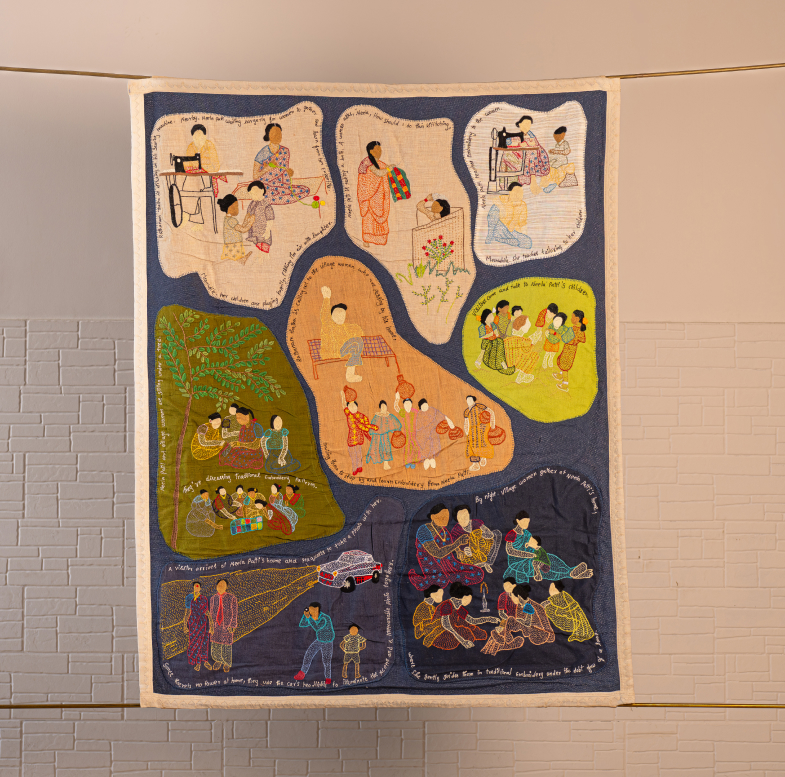
The yellow feels analogue. Tungsten yellow that can only come from coiled wire heating inside a bulb. Eighties yellow that emanated from Ambassadors and Fiats climbing slowly up rough roads. The kind of yellow that speaks of a particular time and a particular physics of light is embroidered in small, running stitches in the bottom corner of a forty-five by forty-five inch cloth. Its source is a car turned sideways, its headlights on.
In 2007, a photographer who had seen Neela Lambadi’s embroidery drove hours up mountain roads, to the Sittilingi Valley in Tamil Nadu, to photograph her. But by the time he arrived, evening had dropped like a curtain. The village was navy blue and still. Neela, who told this story decades later, does not quite remember whose idea it was to use the headlights of the photographer’s car to light up the image. She remembers only that she stood in that glaring electric cone of yellow while the shutter clicked.
This yellow is now embroidered with small, running stitches along the bottom corner of a forty-five x forty-five inch piece of fabric.
This fabric installation is the work of textile designer Sindhu Kamaraj, who spent a month and a half coaxing stories like these out of Neela paati (grandmother in Tamil) and Sindhu’s own grandmother, Gammi paati, and arranging them into embroidered panels for her final-year NIFT project.
In one panel, Neela paati is frozen mid-shower inside a makeshift bathroom. From the other side of the thatched wall, someone voices her doubts about the direction in which an embroidery pattern is going. The work won’t even wait for soap.
Other panels show stories of everyday life—women balancing firewood bundles on their heads; women carrying water in a choreography so elaborate it makes you realise that you have never actually thought about water in terms of weight, distance and labour, but only as something you twist a tap for.
The Lambadis brought their embroidery South to Tamil Nadu centuries ago—it was on everything they wore. The craft disappeared when their traditional dress made way for sarees. It lay dormant for more than two generations, with women who had learned it as girls but had nowhere to practise it. However, it was revived in 2006, when Neela and Gammi started embroidering again and helped form the Porgai Artisans Association (PAA). In the Lambadi language, porgai means pride. Today, the two women have reason to be proud as the collective is a registered society of 60 Lambadi women.
The needles of these women have moved furiously, like they had a consciousness and muscle memory in their metal. And the embroidered products migrated from trousseau trunks to craft exhibitions and art fairs and thus, from domestic spheres to commerce ones. “Earlier, the embroidery followed strict rules. We had a set colour palette and a repertoire of geometric patterns. But we had to rethink and reinvent. If the work stayed exactly as it once was,” Sindhu explains, “it would not travel or sell. The old palette was mostly solid green, yellow, red, white and blue, but now we have opened it up to include violet, orange, brown, black, and other colours shaped by contemporary design.”
Sindhu speaks to Object on the phone from the Porgai centre, where she spends her weekdays; it is 15 kilometres from her home. She faintly remembers her great-grandmother dressed in the traditional Lambadi clothing called petia, a five-piece dress heavy with geometric patterns. It was her grandmother’s generation that moved into sarees, which marked the moment when the embroidered clothes slipped out of daily use and into memory. Some of these garments lie folded like pressed flowers in her almirah at home.
Sindhu moves between two kinds of knowledge. She is NIFT-trained and was taught to compose textiles like sentences and give weightage to layouts and concepts. But she has also learned embroidery the old way, absorbing it like a first language from women who spent years bending over cloth and toiling in farms and fields.
“I'm also from here. So, I know their strengths and also how long it would take someone to complete something,” she says about her role at the centre. In fact, Sindhu is the youngest member of the collective.
If memory and technique are communal, can authorship ever be singular? Sindhu tells me there are arguments among the women but mostly about the details. For instance, in a panel about planting, they argued over a leg, over which leg goes behind and which forward. The women—and their knees too—knew the angle at which their legs were bent. Their hips knew how the body folded when they were bent over the earth for hours. Embroidery, it turns out, can involve fact-checking.
The Lambadi women know the forest like we know our own rooms. So, the stitches often hold what the valley holds: the green bee-eater, Malabar grey hornbills peeking out from a canopy, sunbirds bright as spilled paint, and the lantana plant blooming wild and stubborn across the forest floor.
This valley, with its forests pressing close and fields stretching wide, is where Dr. Lalitha Regi and her husband arrived in 1993, looking for a place that needed them. Dr. Regi started a community health programme and travelled across 21 villages in the Sittilingi and the surrounding hills. When Dr. Regi speaks of Sittilingi, it is mostly through the lens of what migration costs the men who used to live here but have moved out to look for work in cities. “We started realising that yes, migration brings in money, but it also brings about certain health and social issues,” she says.
“So, the question became: how can life here be made livable enough so that some might not leave at all?” she asked. That was the kernel behind Dr. Regi co-founding the Sittilingi Organic Farmers Association, now 700 members-strong. It is also why, in 2006, she helped co-found the Porgai Artisans Association. “I think all of this falls in the responsibilities of a doctor,” she says.
For years, the association made what craft markets wanted—garments, cushion covers and small bags which could be sold at exhibitions in Chennai and Bengaluru. The women were paid fairly, but there was a ceiling price. “The craft market in India is so unfair,” Dr. Regi says. “However fair we are, there is a limit to what the artisan can earn.”
The group barely broke even and made just enough to keep the bank account active. But the art they created was a new beginning. Slowly, the forests around them made their way into the embroidery and the fabrics. “We are also farmers,” Dr. Regi says. “We grow millets. We are surrounded by forests. So, there is a lot of inspiration around us.” She says “we” even though she is originally from Kerala and has moved to Sittilingi. One might be quick to think of her as an outsider, but while walking from village to village for 32 years—learning, listening and belonging—at some unnoticed time, the distinctions blurred.
Similarly, the artists, too, embraced an openness and a willingness to see new shapes in old patterns. It was around the time of the Covid-19 pandemic when the first human figures stepped into the embroidery patterns. “Lambadi predates all the figurative embroidery traditions in India,” Dr. Regi adds. “So figurative was not our thing at all.” But the artisans needed to remind their audience that they were indeed people and so, they began weaving themselves into the embroidery.
When I speak to Sindhu over the phone on a breezy January evening, the network is patchy. The conversation hangs, somewhere between the trees and hills before it reaches me. “These days, parents here are giving more freedom to their children. They don’t want their kids to face the same struggles they did in their life,” she says.
The days, however, follow the same routines. Morning breaks and the men head out to fields of rice, millet and sugarcane. The women go too, but they come back sooner. Between stirring pots and taking care of children who darts further away despite being shouted at, women spread the cloth to be embroidered across their laps. Hands replicate rhythms that have lived in other bodies long before theirs.
I can almost hear Sindhu smiling between words when she says: “There was a time when women had to ask for money to buy anything at all, be it a utensil or a bus ticket or something as small as a bindi. But now, sometimes, it’s the husband who asks the wife for a loan.”


