

The Chanakya School of Craft pushes the boundaries of embroidery—and fashion—by centring the people behind the threadwork.
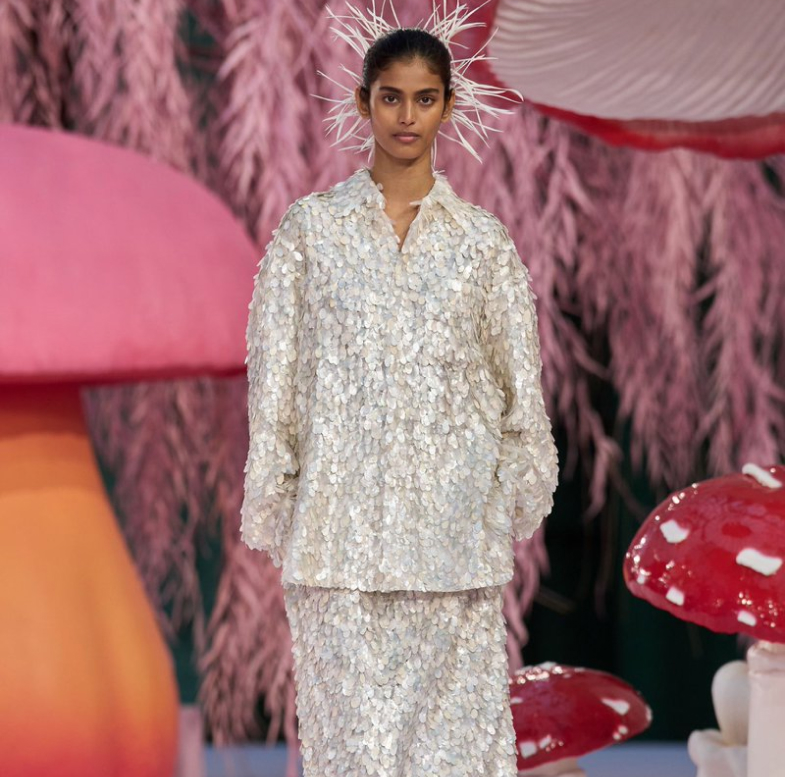
An Indian model, centre stage, closing one of fashion’s most powerful runways. Bhavita Mandava as the bride for Chanel’s Haute Couture Spring/Summer 2026—the moment registered instantly, globally. It arrived in reels, captions, and a declaration of history.
We live in a culture of oversharing. Rapid clicks, likes, and shares. That which is pinned is monumental. Like an etching on a wall from the olden days that reads, “I woz ‘ere”. Fashion, perhaps more than any other industry, has embraced this logic of visibility. What is shared is remembered. What is pinned is preserved.
Scroll through the Instagram page of model Avanti Nagrath. Discovered on the social media platform, she has risen in the fashion world at lightning speed—New York billboards, magazine covers, global campaigns. She documents her journey judiciously to her 138,000 followers. Each image fixes a moment in place. As the feed gets populated, her past slips further down.
But her pin, for now, is forever.
It takes us back to February 25, 2022, to the MiCo Convention Centre in Milan. Day four of Milan Fashion Week. Versace Fall/Winter 2022.
The show’s all-star model cast is picked by none other than the powerhouse behind DM Casting Agency, Piergiorgio Del Moro, one of fashion’s most powerful gatekeepers alongside Samuel Ellis. Together, they book models “no one else can book”, as New York Magazine once put it. The lineup reads like a snapshot of the moment: Bella and Gigi Hadid, Mona Tougaard, Precious Lee, Mica Arganaraz, Kate Moss’s daughter Lila Moss, Emily Ratajkowski and Avanti Nagrath.
Backstage, everything is visible. Pat McGrath waves her magic makeup wand, creating a smouldering black eye, edgy but chic. Guido Palau is on hair: sleek, straight, inspired by the 80s, channelling Annie Lennox. The indisputable muse is Julia Fox, who is soon to take her place in the front row. Boundaries blur between information and marketing. The soundtrack goes live on Spotify as a public playlist titled Versace FW22. Even before the first model walks, the show is already archived.
Sound check is underway, and the DJ is told to make it feel like a club. Lace it liberally with nostalgia for the 90s and Y2K, when partying was an essential preoccupation of any IT girl worth a mention. The runway is designed like a maze; you see the models and then you don’t. Neon strobe lights flash over a lacquered red floor. The room goes dark. The show begins.
Avanti Nagrath, discovered at fifteen, opens the show in a sharp black tailored pantsuit as Lewis Of Man’s Sorry Not Sorry plays, its lyric cutting through the room: “I’m sorry I kissed your girlfriend.” The Versace monogram glows overhead. It’s electric. Donatella Versace later describes the cast as “championing diversity,” praising a new-generation attitude.
This is Versace of the late nineties and early 2000s (IYKYK): bustiers, latex leggings, slinky and fitted dresses, and sex appeal. A big India moment. One for the books. One for the papers.
Look fifty. Emily Ratajkowski steps out. The track drops into a soft house beat. She’s wearing a green, shredded-looking dress that’s slashed and cut, with chains draped around the body, exposing a bra and a corset underneath—a long-time fixation tied to Gianni Versace’s love for chainmail. The international press can’t get over the dress. Close-ups circulate and captions gush. Ratajkowski later shares a close-up of the details on Instagram: It never gets less surreal.
It was as Versace as it gets.
And yet, in this flood of information, on a catwalk celebrated for hosting India’s outing, one fact is missing.

The embroidery on that green dress, much like Nagrath herself, originates in India. Its ornamentation began its journey not in Milan, but in an embroidery unit in Byculla, Bombay. As Ratajkowski walked down the runway in chunky black boots, there was no betraying the fact that this piece—its embellishment, its surface drama—was the work of Indian hands. The garment travels; the maker rarely does.
It is a rather curious world, this world of luxury fashion. While provenance is often gushed over, labour (and all the baggage that comes with it) is a matter of great hush-hush. The embroidery, from cuff to hemline, is executed by master craftspeople in India—often the source and site of this labour. But hey, we don’t talk about that here.
Sorry Not Sorry.
Through narrow bylanes in Byculla, past hutments, low buildings, the Hancock Bridge built by the British, and the infrastructure of old Bombay, rises a tall tower.
This is where the green dress was made. Internally, Ratajkowski’s look is referred to as the Olivine Cascade fringe dress. It was embroidered at the Chanakya atelier with a fine needle. Zardozi, rooted in classical traditions, is modernised with cascading chain fringes. Each strand is made by hand using new-cut stones, faceted chain stones, and polished metal chains.
The dress appears distressed, almost torn, but the effect is engineered. Each strand is individually placed, measured meticulously. The length, weight, and density are carefully calibrated to shape the contours of the body. The fringe falls in measured sequences, elongating the body. As Ratajkowski walks, the embroidery catches and releases light. On the runway, it is a spectacle, inside this building, it is both a science and an art.
The offices of Chanakya look like a transplant. The lift opens onto what could be an office in London, Paris, New York, or Milan. Yet, it sits in the heart of Bombay’s embroidery district, where young boys and men are still hunched over khakas on the floor.
Founded in 1984 by Vinod Shah, Chanakya began as a group of twelve master artisans who had travelled to Bombay from across India. Shah later established connections with European fashion houses during his travels, eventually building a bridge between India and the world.
A video plays on a screen. The story of how the company began, then fashion. One show after another, one catwalk after another. The image fractures into a grid of runways: Adut Akech at Fendi, Nora Attal at Dior, Cara Delevingne at Fendi, Emily Ratajkowski at Versace.
Then names appear on the screen. Versace. Fendi. Maison Martin Margiela. Gucci. Alberta Ferretti. Dsquared². Marni. Prada. Moschino. Valentino. Christian Dior. Balmain. All clients of Chanakya.
One year after Emily Ratajkowski walked the Versace runway, Dior came to Bombay.
Models walked at the Gateway of India in celebration of India’s craft moment, marking thirty years of collaboration. At the heart of that runway was the toran, an object decorating thresholds, which is used across cultures in India to welcome the goddess.
Ten minutes from the Gateway of India stands the Chanakya School of Craft—where 300 master artisans crafted the toran featuring twenty-five embroidery techniques, from phulkari to mirror embroidery and kantha, carrying motifs of elephants, mandalas, lotuses, Kamadhenu, tigers, and peacocks.
That is 35,000 hours of work.
For decades, India functioned as the backroom of Western fashion. As a Harvard Business School paper on global luxury supply chains once noted, value was “created in design capitals but executed elsewhere”. What is shifting now is awareness. India is no longer dressing the world quietly; it is dressing itself, loudly and knowingly, as a market in its own right.
At the centre of this shift is Karisma Swali—Shah’s daughter—who runs Chanakya today. She pushes the boundaries of what embroidery can be, and who gets to make it. Swali wants to bring more women into embroidery, which is predominantly a male preoccupation in the Indian couture scene. Through the Chanakya School of Craft, young women across Bombay undergo three-year training programmes, learning skills that were once passed down informally, but are now formalised with agency and intent. In many ways, this is where fashion meets feminism.
Swali describes the Dior show as “a reflection of complete freedom in imagination and the collective energy of everyone involved.” For India, it was a moment of patronage that recognised invisible labour, and a reminder of how rare such naming still is.
If Maria Grazia Chiuri, the woman who put We Should All Be Feminists on a T-shirt, made feminism visible on the runway, Karisma Swali has been making it possible behind the scenes. Feminism in fashion cannot stop at slogans. It must extend to those who make the clothes, under what conditions they do so, and whether or not they get recognition for it.
Chanakya’s work extends beyond fashion. The atelier has embroidered Judy Chicago’s panels and collaborated with Manu and Madhvi Parekh on textile-based artworks shown as wall hangings in couture contexts. Here, embroidery is no longer backdrop or embellishment. It enters the realm of high art.
The question is no longer whether Indian craft belongs on the global stage, but rather who- and-what-we choose to applaud for. Bestowing easily recognisable faces who already have access with more of it is hardly a thing to celebrate. Can we also centre those who don’t play directly to the capitalist galleries?


